Verb (Irregular) (Basic ㊦ 434)
Someone or something has some (semi)permanent attribute.
Equivalent: Have
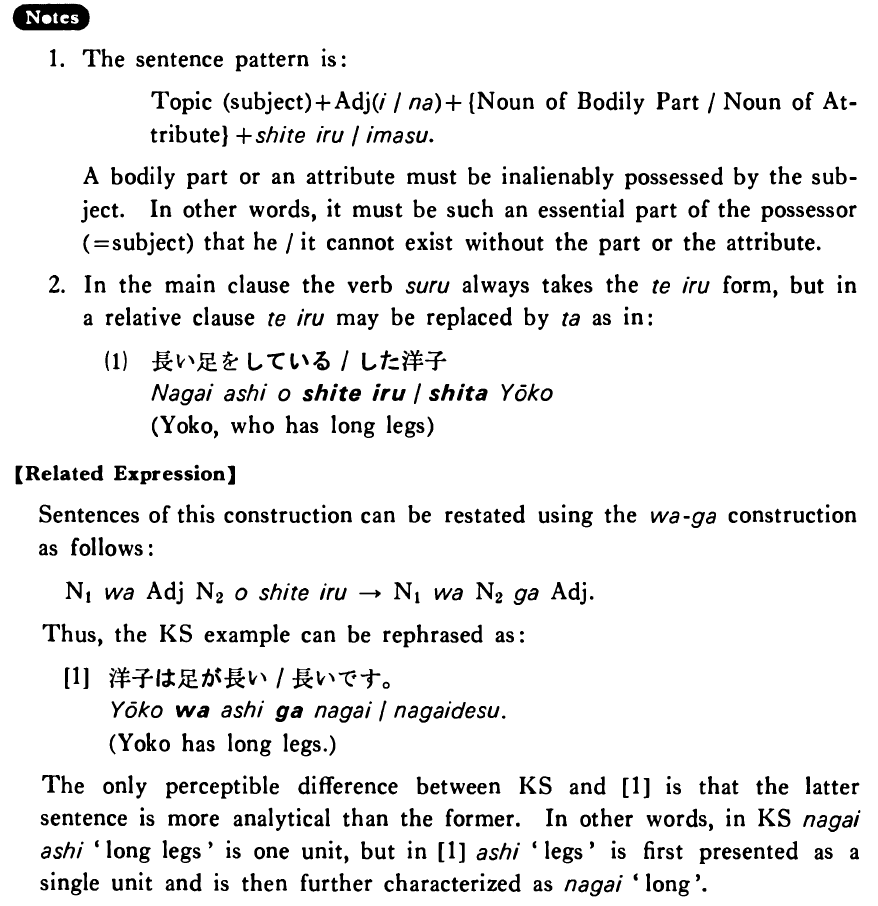
1. The sentence pattern is:
A bodily part or an attribute must be inalienably possessed by the subject. In other words, it must be such an essential part of the possessor (=subject) that he/it cannot exist without the part or the attribute.
2. In the main clause the verb する always takes the ている form, but in a relative clause ている may be replaced by た as in:
【Related Expression】
Sentences of this construction can be restated using the は~が construction as follows:
Thus, the Key Sentence example can be rephrased as:
[1]
The only perceptible difference between Key Sentence and [1] is that the latter sentence is more analytical than the former. In other words, in Key Sentence 長い足 'long legs' is one unit, but in [1] 足 'legs', is first presented as a single unit and is then further characterized as 長い 'long'.